Redwood National Park Information Page

Welcome to the Redwood National Park Information Page.
Here you will find all you need to know about the natural history of the park.
Learn about the geology, trees, mammals, birds, or other plants and wildlife of the area.

-SPONSORED LINKS-
Redwood National Park Lodging
Redwood National Park Hotels
Redwood National Park Maps
Redwood National Park Camping
Redwood National Park Weather
Redwood National Park Vacation Rentals
American Kestrel

Sponsored National Park Search

American Kestrel - Corel ©

Redwood National Park Information

  • Canoe History
  • California Conservation Corp
  • Endangered Wildlife
  • Establishment
  • Forest Wildlife
  • Geology
  • Gray Whale
  • History
  • Index
  • Ocean Information
  • Outdoor Schools
  • Plants
  • Prairie Information
  • Redwood Burls
  • River and Streams Info
  • Size and Visitation
  • Tall Trees
  • Wildlife

  • 
    

    Establishment

    Redwood National Park was established on 02 October 1968 and expanded on 27 March 1978.

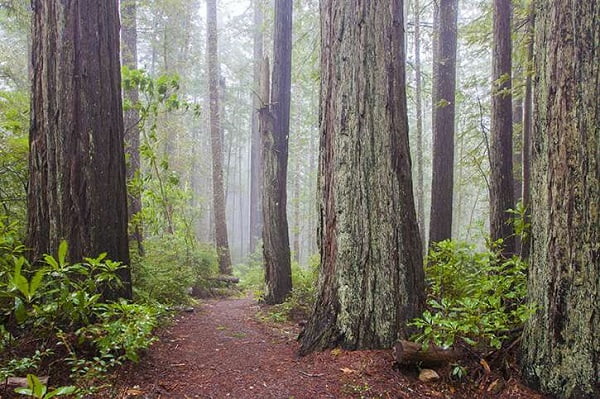
    Redwood National and State Parks protect old growth coast redwoods, some of the world's tallest trees. Less well-known are the prairies and oak woodlands and the coastal and marine ecosystems. Three California state parks and the National Park Service unit represent a cooperative management effort of the National Park Service and the California Department of Parks and Recreation. Together these parks are a World Heritage Site and International Biosphere Reserve protecting resources cherished by citizens of many nations.

    Designations

    Designated a World Heritage Site on 2 September 1980
    Designated an International Biosphere Reserve on June 30, 1983


    Size and Visitation

    Of the total 112,597.58 acres, 77,699.63 are federal and 34,897.95 are state
    Land area is 104,293.02; submerged area is 5,939.38
    Del Norte County federal acreage is 8,008.45 and state is 19,658.77
    Humboldt County federal acreage is 67,443.39 and state is 15,121.79
    Old-growth forest federal acreage is 19,640, with the state having 19,342 for a total of 38,982.

    Visitation to the park is highest in June, July, August, and September and lowest in January with total recreational visits in 1999 at 369,726.


    California Conservation Corp

    During the 1930s, Prairie Creek Redwoods State Park was the home of the Civilian Conservation Corps Company 1903. The company, which consisted of between 186 and 193 young men, was housed in a temporary camp built in nearby Boyes Prairie, now known as Elk Prairie.

    The most impressive achievement of the CCC was the construction of the "concession and recreation building" which is now the Prairie Creek Redwoods State Park Visitor Center. With the exception of the window lights, plumbing, and chimney flue, all the materials for the building were constructed of natural materials salvaged from an earlier cleanup of the prairie area.

    The building is an excellent example of the rustic "back to nature" ethic that dominated National Park Service construction in the 1920s and 1930s. In an attempt to restore the prairie to its natural state, the building was constructed to blend in with the surrounding environment.


    Tall Trees

    The coast redwood, whose scientific name is Sequoia sempervirens , is the tallest known plant species in the world. It is also the fastest growing conifer, or cone-bearing tree, in North America.

    Coast redwoods are among the oldest living things on earth. The oldest known specimen was logged in 1933. A count of the growth rings revealed that the tree was 2,200 years old. Most redwoods, however, live an average of six centuries.

    The tallest known redwood (the "Tall Tree") is about 600 years old. It is located on Redwood Creek within Redwood National and State Parks, near Orick, California. The Tall Tree was measured at 367.8 feet by the National Geographic Society in 1963. The top of the Tall Tree broke off recently. New measurements by the National Geographic Society in 1995 revealed the "National Geographic Tree" measured in 1963 to be the third tallest tree in the world, is now the tallest. It, too, is located in Tall Trees Grove.

    From a seed no bigger than one from a tomato, California's coast redwood (Sequoia semperviren) may grow to a height of 367 feet (122 m) and have a width of 22 feet (7 m) at its base. Imagine a 35-story skyscraper in your city and you have an inkling of the trees' ability to arouse humility.

    Some visitors envision dinosaurs rumbling through these forests in bygone eras. It turns out that this is a perfectly natural thought. Fossil records have shown that relatives of today's coast redwoods thrived in the Jurassic Era 160 million years ago. And while the fantastic creatures of that age have long since disappeared, the redwoods continue to thrive, in the right environment.

    California's North Coast provides the only such environment in the world. A combination of longitude, climate, and elevation limits the redwoods' range to a few hundred coastal miles. The cool, moist air created by the Pacific Ocean keeps the trees continually damp, even during summer droughts. These conditions have existed for some time, as the redwoods go back 20 million years in their present range.

    Exactly why the redwoods grow so tall is a mystery. Theories continue to develop but proof remains elusive.The trees can reach ages of 2,000 years and regularly reach 600 years.

    Resistance to natural enemies such as insects and fire are built-in features of a coast redwood. Diseases are virtually unknown and insect damage insignificant thanks to the high tannin content of the wood. Thick bark and foliage that rests high above the ground provides protection from all but the hottest fires.

    The redwoods' unusual ability to regenerate also aids in their survival as a species. They do not rely solely upon sexual reproduction, as many other trees must. New sprouts may come directly from a stump or downed tree's root system as a clone. Basal burls, hard, knotty growths that form from dormant seedlings on a living tree, can sprout a new tree when the main trunk is damaged by fire, cutting, or toppling.

    Undoubtedly the most important environmental influence upon the coast redwood is its own biotic community. The complex soils on the forest floor contribute not only to the redwoods' growth, but also to a verdant array of greenery, fungi, and other trees. A healthy redwood forest usually includes massive Douglas-firs, western hemlocks, tanoaks, madrones, and other trees. Among the ferns and leafy redwood sorrels, mosses and mushrooms help to regenerate the soils. And of course, the redwoods themselves eventually fall to the floor where they can be returned to the soil.

    The coast redwood environment recycles naturally: because the 100-plus inches of annual rainfall leaves the soil with few nutrients, the trees rely on each other, living and dead for their vital nutrients. The trees need to decay naturally to fully participate in this cycle, so when logging occurs, the natural recycling is interrupted.

    California's "Redwood" Trees: Giant Sequoia and Coast Redwood

    There are three members of the redwood family: coast redwoods (Sequoia sempervirens) of the California coastal fog belt, giant sequoias (Sequoiadendron giganteum) of the Sierra Nevada, and dawn redwoods (Metasequoia glyptostroboides) of central China. The names sequoia and redwood are often used interchangeably, leading to confusion between the two California members of this family, but they are very different trees.

    Almost all remaining giant sequoias are now safe from the axe and saw; about one-third were cut before being protected. Old growth coast redwood continues to be cut for lumber today, with only a small part of its original uncut acreage still remaining. Of the estimated 1,950,000 acres of coast redwood originally occurring in California, only about 4.4%, or 86,000 acres of old growth, remain. About 80,000 acres of this old growth is protected in parks and reserves.

    Coast Redwood Facts

    Giant Sequoia Facts


    Plants of the Redwoods

    The ancient forests of the Pacific Northwest, containing as many as 25 different species of conifers, are dominated by only a few. Sitka spruce dominates southeast Alaska and coastal British Columbia, while Douglas fir dominates in Oregon, Washington, and inland British Columbia. The stately coast redwood (Sequoia sempervirens), largest of all, dominates in northern California.

    Only in old growth forests are all of the following characteristics present:

    Large Living Trees and a Multi-Layered Canopy

    Old and younger trees grow together in a mixture of species. The larger trees often have wind-damaged tops and larger but relatively fewer branches. A thick growth of mosses and lichens harbors many insects, birds, and small mammals. These forests are efficient at trapping large amounts of moisture. The uneven canopy can even retain moisture from fog during the drier seasons.

    Large Standing Snags

    Dead snags may remain standing for many decades. Insects and woodpeckers open up this dead wood, providing habitat for many other species. In turn, these species become food for larger predators, such as the northern spotted owl, marten, and black bear.

    Large Down Trees

    Logs criscross the forest floor and help hold steep soils in place. Like living trees, these downed logs can hold extraordinary amounts of water and provide food and shelter for wildlife.

    Large Fallen Trees in Streams

    Fallen trees lie in random patterns in small streams. Since the water flow in these streams is not powerful enough to move large logs, they form semi-permanent "stairsteps" that hold woody debris in place and stabilize the streambed.

    Fish populations benefit by consuming insects harbored in the debris. They also benefit from the shelter provided by fallen logs. Recent research indicates that fish are heavily dependent on old growth forests. Their populations suffer as a consequence of old growth destruction.

    Other Vegetation

    Visitors often come just to see the redwoods. They are the world's tallest trees, but they are also just one species in an incredibly varied ecosystem. From the wind-pruned, salt-tolerant Sitka spruce by the seaside, to the cool, moist redwood groves, and sunny, open grasslands of the prairies, visitors can find an interconnected community of greenery.

    In this narrow zone where land meets sea, salt-laden winds, cold fog-shrouded days, steep slopes, and sandy beaches conspire against plants. Only the toughest survive. Their stunted size and wind-pruned shapes bear witness to an ongoing bout with the parks' harshest environment.

    Dunes shift with the action of wind and water. Beach pea, beach strawberry, and sand verbena adapt to this dynamic environment by anchoring themselves with long runners on or below the surface.

    Hardy Sitka spruce (Picea sitchensis), able to withstand salt winds and harsh conditions better than other conifers, dominate the most exposed forest sites. Crescent Beach, Gold Bluffs Beach, Freshwater Lagoon Spit, and the Coastal Trail are great places to discover these tenacious maritime residents.

    The coast redwood (Sequoia semperviren) and Douglas-fir (Pseudotsuga menziesii) are the two dominant trees of the old-growth redwood forest. The species associated with redwood groves varies according to whether an area is upland, streamside (riparian), along a flood plain (alluvial), or close to the ocean.

    Salt spray and salt-laden wind injure redwoods; the beach, dune, and scrub communities provide the coast redwood with a buffer from the harsh coastal climate.

    The protected valleys and alluvial flats found along streams and creeks provide ideal growing conditions for the coast redwood, with many trees exceeding 300 feet (100 meters) in height. Other trees include hardwoods such as tanoak (Lithocarpus densiflora), madrone (Arbutus menziesii), big-leaf maple (Acer macrophyllum), California bay or laurel (Umbellularia californica), and red alder (Alnus rubra). Sword fern (Polystichum munitum) and redwood sorrel (Oxalis oregana) are the most common members of redwoods' understory, and are accompanied by rhododendron (Rhododendron macrophyllum), huckleberry (Vaccinium spp.), salal (Gaultheria shallon), azalea (Rhododendron occidentele), and other shrubs.

    On dry, windy slopes and ridges, redwood growth is limited by water stress. Here, trees may reach an average height of 200 feet (61 meters) or less.

    At higher elevations, and further inland, redwood seedling establishment is limited by hotter, drier conditions, and the redwood forest gives way to a mixed evergreen forest. Dry forest species include Douglas-fir, tanoak, madrone, California bay, chinquapin (Chrysolepis chrysophylla), canyon live oak (Quercus chysolepis), and Jeffrey pine (Pinus jeffreyi).


    Canoe History

    The Yurok people are closely tied to water. Fish and eels were the traditional staple foods along with acorns, berries, and deer meat. People traveled by foot on the many trails through the steep mountainous areas of northwestern California and by canoe along waterways. They fished, eeled, hunted, gathered food and basket-making materials, visited friends and family, traveled to ceremonial dances, and traded all types of items by canoe up and down the Klamath River. Traded items included twined women's ceremonial hats and tanned deer hides. Longer, sturdier, ocean-going canoes were used to hunt seals, catch fish off-shore, and ferry people and goods along the coast.

    The canoe was an essential part of each family's household, without which the families would be limited to local travel or to paying someone else, usually with dentalium shell money, for a ride to their destination. Canoes were also used for the Boat Dance, an integral part of the White Deerskin Dance, which was held every two years as a world renewal ceremony.

    Traditional Construction

    Coast redwood trees (Sequoia sempervirens) have always been the wood preferred by Yuroks for canoe-making. Not only was the wood found in abundance in the coastal areas of northern California, but it is also resistant to insect damage and rotting, both essential to the longevity of a canoe left year-round on the river bank. Traditionally, trees that were knocked over in a storm or felled by lightning were used for canoe- making. It was very difficult to fall a massive redwood tree with small tools; only rarely would a carver use an elk horn wedge and stone maul to cut down a standing tree. When choosing a tree, the canoe-maker looked for one that would not split easily and would produce a solid, sturdy canoe.

    To begin a canoe, the log was split into two sections lengthwise producing "blanks" for two canoes. Often, the logs or blanks would be left in a shady, cool place for up to a year to "season," further ensuring the soundness of the wood. When the carving began, what had been the center, or interior, of the tree became the bottom of the canoe. What had been the outside of the tree became the top of the canoe. This was done because the interior wood is a much tighter grain and therefore heavier. Also, the interior has fewer knots.


    Pioneer History in the Redwood Area

    Redwood National Park contains the tallest living things on earth, evergreen trees that grow to 350 feet. The park was established specifically to protect these trees, because it is only here and in Oregon that they now survive. Descendants of the giant evergreens that grew during the age of the dinosaurs, redwoods thrived in moist temperate regions of the world. They take 400 years to mature and some of the survivors are more than 2,000 years old. Their thick, sapless bark protects them from fire, but landslides and wind can topple old trees. The Indians used fallen redwood trees to build canoes and houses; commercial logging began during the gold rush era. Logging of redwoods continues and is debated by the timber industry and environmentalists. The trees stand as majestic reminders of the slow evolution of nature. Redwood National and State Parks represent a cooperative management effort of the National Park Service and the California Department of Parks and Recreation. Together these parks are a World Heritage Site and International Biosphere Reserve protecting resources cherished by citizens of many nations. (Inscribed in 1980)

    Mining

    Spaniards and Anglos largely ignored the northern California coast until the Gold Rush. Gold was discovered at Gold Bluffs Beach in the 1850's. Mining proved marginally profitable. Although some mines were reopened after the Civil War, they closed again shortly thereafter. Small-scale mining continued sporadically until about 1920. The remains of mining operations can still be seen in the Gold Bluffs area.

    Logging

    Logging began in the Redwood region in 1851. At first, logs were floated to small mills or dragged by oxen on skid roads. By the 1870's logs were hauled to mills by rail. In 1882, an invention called the "steam donkey" was used. During the 1890's, the steam donkey was replaced by the "bull donkey." In the 1920's, caterpillar tractors were first employed. Since the 1940's, trucks have been used to haul logs. Redwood lumber is well-known for its resistance to decay and was once a very popular wood for home-building. Outstanding redwood Victorian-style homes and other structures are still visible in Eureka, Ferndale, and San Francisco.


    Redwood Burls

    Burls in coast redwood are masses of stem tissue where elongation of the many stem tips has not occurred. They are anatomically similar to tissues in eucalyptus called "lignotubers" by the Australians.

    Burls develop from axillary buds in the seedling redwood. This "basal burl" (sometimes called a bud collar) persists, growing larger throughout the life of the tree. The dormant stem tips continue slow growth and branching, but do not elongate. Unlike aerial stems of redwood, burl tissue grows downward. It forms an enlarged mass near the base of the tree above or below the soil surface. Burl tissue overgrows the root tissues at the base of the tree. Burls may also occur well up the main stem and on branches.

    Adventitious (hanging) roots often develop from burls, particularly near the soil, but no stems develop on redwood roots. "Stump" sprouts from the burl are often incorrectly called "root" sprouts, but there is no known instance in which stems have developed from root tissue in redwood. Dormant buds rapidly elongate after the biochemical dominance of the main stem is removed (such as when the tree is cut). In undisturbed forest stands, a few trees may sprout from the burl. These sprouts, growing under the canopy of the main stem, are at a physiological disadvantage and rarely reach large size. In this regard, they are like branches which eventually die when severely shaded by other branches.

    The ability to sprout is rare in conifers, but in redwood it is an alternative to regeneration by seed. When a tree breaks off near its base or is cut, new stems arising from the remaining burl tissue may produce one or more stems which can rapidly take the place of the parent stem. In some cases, this may occur over several "generations," leading to rings of sprouts around the site of the former tree. Regeneration from seed is more common in the northern range of the redwood. This observation is based upon the large proportion of single-stemmed to multiple-stemmed trees.

    Small burls can be purchased in shops in the redwood region. By placing these in a shallow tray of water, the dormant buds will sprout. Roots rarely develop, but if they do, the sprouted burl can be "planted" in a moist shaded spot and may develop into a tree on its own.

    "Birds eye" wood is burl tissue. The birds-eye effect results from sawing across the "knots" or bud traces of the dormant stems embedded in the associated woody tissue.

    In addition to this normal burl tissue, there are similar-appearing growths on redwood stems which are anatomically different. These are outgrowths of cambium without buds. They do not sprout, but have sweeping swirls of annual layers of wood instead of the birds-eye character.

    Burl tissue also occurs in a number of other species in the redwood forest, including bigleaf maple (Acer macrophylum), California bay (Umbellularia californicum), rhododendron (Rhododendron macrophyllum), and huckleberry (Vaccinium parvifolium).

    Written by Stephen D. Viers, Jr., Research Scientist, Redwood National and State Parks, Arcata, California 95521. February 1984.


    Geology of the Redwood Region

    Seismic Activities

    The North Coast region, which includes Redwood National Park and the adjacent offshore area, is the most seismically active region in the United States. As a result of frequent earthquakes, rapid uplift rates have led to landslides, actively braiding and shifting rivers, and rapid coastal erosion.

    The reason for all this activity is the geologic setting of the North Coast region. Three tectonic plates (thin pieces of the Earth's crust which float above the mantle) known as the North American, the Pacific, and the Gorda contact each other at the Mendocino triple junction. This junction lies offshore near Cape Mendocino, which is about 100 miles (160 km) southwest of Redwood National and State Parks.

    Each of these plates slide against each other as they slowly move in opposing directions. Movement may be as much as two or three inches (5-6 cm) a year. Many times, this movement comes in the form of earthquakes, when built-up energy is released along fault lines that border the plates. Although the majority of these earthquakes are too small to be noticed, larger quakes are not uncommon.

    Geologists believe that continents are basically rafts of light rock floating on the heavy black volcanic basalt of the earth's mantle. This same basalt makes up the bedrock of the sea floor. The heat of the earth's inner core expands and partially melts this rock so that it becomes less dense than surrounding rock. This less dense molten rock (magma) rises, breaking through the ocean floor along the mid-ocean ridge. This magma then cools and re-solidifies, making new ocean floor. As more magma rises from beneath, this new rock is pushed farther and farther away from the ridge.

    As this "conveyer belt" of new ocean floor continues its long journey towards North America and Asia, it collects ocean sediments and other debris. Along the edge of North America, sediment-covered ocean floor collides with the continental plate. The force of this collision continues to create the Great Valley and Coast Range of California.

    The coast range consists of the most recent bedrock and sea floor sediments to be welded onto the North American continental plate.

    In the 1990s, at least nine magnitude 6.0-plus earthquakes jolted the North Coast. This amount of large quakes was higher than in any other decade within the last century. Most of these quakes occurred offshore, resulting in one death and major financial losses. Because the Gorda plate is subducting beneath the North American plate, there is the possibility of a "great earthquake" occurring in the future.

    Scientists believe that the two plates are partially locked together along a contact known as the Cascadia subduction zone. The frozen boundary between the two plates is called the megathrust. The megathrust is broken from time to time, but usually along small parts of the fault, resulting in small quakes. However, if a larger part is broken, a magnitude 8.0-plus quake is possible.

    Earthquakes

    Studies have shown that the last great subduction zone earthquake took place 300 years ago. Intervals between such quakes are in the hundreds of years, so predicting the next one is difficult. But research suggests that eventually such a quake will occur. Disastrous effects are possible when visiting the redwood region; be prepared by following these precautions:

    Falling objects cause the most deaths during earthquakes. If you are indoors, take cover under a sturdy desk, table, or other furniture. Hold onto your shelter and stay there until shaking stops. Stay clear of windows, fireplaces, wood stoves, and heavy furniture or appliances. Stay inside!

    If outside when a quake hits, get into the open and away from trees, power lines, and buildings.

    If you are driving when a quake hits, stay away from bridges, overpasses, and tunnels and avoid stopping under trees, light posts, power lines, or signs.

    If you are in a mountainous area or near unstable slopes or cliffs, be alert for falling rock and other debris that could be loosened by the earthquake.

    If you are at the beach or near the coast when a quake hits, tsunamis can arrive within minutes. Move to higher ground (at least 100 feet) immediately, preferably on foot.

    Tsunami

    Tsunami is a series of ocean waves most commonly caused by an earthquake beneath the ocean floor. They can be caused by local quakes, such as in 1992, when a Cape Mendocino quake produced a tsunami that hit Humboldt Bay within 20 minutes. Tsunamis can also be caused by quakes in far away areas, such as in 1964, when an earthquake in Alaska produced a destructive tsunami that inundated Crescent City.

    Tsunamis have killed in the past. They are always a possible threat in the seismically active North Coast region, however, destructive tsunamis are rare and shouldn't ruin your visit to the beach.

    In the event that you do find yourself near the coast when an earthquake hits, be aware of the following guidelines:

    Categories of Rocks Found Here

    The rocks found in Redwood National and State Parks are part of this crumbled belt of sediments and generally fall into one of three categories:

    Sedimentary Rocks - sandstones, mudstones, and conglomerates. Conglomerates are formed from assorted pebbles cemented together in a sand matrix. The porous and permeable structure of these rocks makes them important aquifers (reservoirs and conductors of ground water) for the redwoods.

    Metamorphic Rocks - such as Redwood Creek schist, are formed when sedimentary rocks are subjected to enough heat and pressure to melt and recrystallize some or all mineral components. This can also occur locally when rocks are crushed as a result of faulting.

    Transitional Rocks - sedimentary rocks that have been slightly metamorphosed. For example, pebbles in a conglomerate are deformed, but the rock still has the appearance of a conglomerate.

    The Rock Cycle

    Magma cools and crystallizes to become Igneous Rock, which is weathered, eroded, and transported to become Sediments. Sediments undergo lithification (become cemented together) to become Sedimentary Rocks, which can be metamorphosed (subjected to heat and pressure) to become Metamorphic Rocks. Metamorphic Rocks and sedimentary rocks can be melted to become Magma.

    When the earth first formed, it was a massive ball of hot molten rock, or magma. Thus, all the earth's rock began as magma. As magma cools, it crystallizes to form igneous rocks, one of the three rock groups. When igneous rocks undergo weathering and transportation, they become sediments. Sediments can then be hardened and cemented together by a process known as lithification, which forms sedimentary rocks. The third rock type, metamorphic rock, is formed when sedimentary rock is changed by great heat and pressure, a process called metamorphism.

    The rock cycle has many pathways. For example, igneous rocks can undergo metamorphism to become metamorphic rocks. Likewise, sedimentary and metamorphic rocks can be exposed to weathering and erosion to form new sediments.

    In most places, such as in Redwood National and State Parks, rocks are hidden at the surface by a layer of soil, water, or vegetation. But beneath this cover, rocks occur everywhere in one form or another. The geologic map shows the approximate location of the bedrock which lies under the surface soils.

    When the ocean sediments here were crushed against the North American continent, they formed the Franciscan Assemblage; the folding and faulting of the earth that accompanied its formation also produced the coast ranges. Serpentinite and Redwood Creek Schist are metamorphic rocks formed under high to low levels of temperature and pressure. The Gold Bluff Formation is made up of sediments deposited at the ancient mouth of the Klamath River. The Gold Bluff Formation earned its name from the presence of very fine gold particles mixed with black sand.


    Wildlife

    A variety of wildlife species call Redwood National and State Parks home. The diversity of ecosystems in the parks means that creatures as different as black bears, sea stars, and bald eagles can be seen by a lucky visitor in a single day. In addition to the more common inhabitants, many threatened and endangered species rely on the parks' old-growth forests, open prairies, estuaries, and the coastline for crucial havens of survival.

    Marine mammals such as sea lions and gray whales are among the most visible wildlife in the parks. Visitors are also likely to see Roosevelt elk browsing in the prairies. Pelicans, ospreys, and gulls are frequently spotted along the coast. Of course, tidepool creatures aren't likely to run very far at your approach, so anenomes and crabs are easy to spot too.

    While you're out watching wildlife, remember that all wildlife is protected in the parks. Never feed or approach animals such as bears, mountain lions, elk, chipmunks, racoons, or rabbits. Please treat the members of this natural community with respect.

    Marbled Murrelets

    The Marbled Murrelet or "Fog Lark" is a small ten-inch-long seabird about the size of a robin which nests in trees from Alaska to central California. Scientists believe they nest only in the high canopy of ancient coastal forests. They seek food in the nearby ocean. Marbled murrelets are rare, and became listed in 1992 as an endangered species by the California state government. Debates on the importance of protecting endangered species often include this species.

    The first murrelet nest was discovered in 1974, making murrelets the last species in the United States to have their nesting habits discovered. Murrelets are usually heard more often than seen. They have a high-pitched "keer" call best heard around sunrise. Murrelets are very fast flyers with quick wingbeats, a short stubby body, and small wings. Chicks are downy and tan-colored with dark speckling; they are born with webbed-feet. Since murrelets rarely come down to the forest floor, you should report any murrelet found on the ground immediately to a ranger. This will result in proper care and eventual release at sea.

    There are several reasons why murrelets nest only in the canopy of ancient forests. Their plump bodies are not very aerodynamic. Their flight is characterized by sharp drops; many wingbeats are necessary to make much forward progress. The tops of towering trees make easy landing platforms. Murrelets nest on large flat limbs, where they usually lay eggs on thick beds of moss already growing there. These accumulations of moss are found most frequently in older trees. In addition, nesting in the high canopy protects murrelets from many predators. Due to their dependance on ancient forests, murrelets have become endangered as stands of ancient forest have disappeared.

    Preliminary studies indicate that the greatest density of these birds in the United States is within Redwood National and State Parks. Researchers have developed techniques for monitoring marbled murrelets using radio telemetry. Studies are also being conducted on their habitat requirements and behaviors. This research will provide park managers with more information and greater ability to protect this endangered species. Current protection plans include limiting use of power tools by park staff to preserve the forest quiet during the breeding season in early fall.

    Avoid making loud noises that might disturb birds and frighten them away from their nests. Don't leave food scraps which may draw predators such as jays and ravens into murrelet habitat.

    The controversy around this small seabird highlights the importance of the Endangered Species Act passed by Congress in 1973. The Act provides the public with an opportunity to protect endangered species and plan for their recovery. Habitat loss from human actions such as intensive logging or water diversion for irrigation or hydroelectric power is the chief contributing factor to species becoming endangered. When private individuals or organizations seek to use publicly-owned natural resources for economic gain, invoking the Endangered Species Act can cause conflict.

    Each species contributes to the richness and diversity of life. No species exists separate from others; all are tied together in the interdependent web of life. Valuing one species above all others and denying the importance of a species to the whole system may profit some of us in the short term. Long-run consequences for all of us, however, are often costly. The extinction of one species may cause a domino effect leading to the extinction of others.

    Black Bear

    Seldom seen, black bear roam throughout the park. They favor recently logged Redwood Creek area whose re-vegetation fosters abundant food. Fond of acorns, bears travel far to harvest them. These bears have generally not lost their fear of humans. The best way to prevent wild bears from becoming problem bears is to keep human food away from them. Use sound food storage practices. Counter-balance all food, scented items (soap, toothpaste, lotion, etc), and garbage in a tree; 12 feet up and 10 feet out from the trunk; and 5 feet down from the branch. Ask a ranger for proper techniques. Remember a fed bear is a dead bear.

    Cougars

    Mountain lions, or cougars, roam throughout Redwood National and State Parks. Although they have been spotted in picnic areas and along trails and roads, your odds chances of seeing one of these secretive animals are low.

    In May 1994, several sightings of a mountain lion along Redwood Creek Trail near the parking lot caused the trail to be closed temporarily. Mountain lions have been known to attack people and pets, but there has never been a reported attack on humans in the north coast redwood parks. The likelihood of encountering an aggressive lion is very remote. People are more likely to be struck by lightning than attacked by a mountain lion.

    Nevertheless, it is wise to be prepared. Avoid hiking alone. Watch children closely. Do not let children run ahead of you on the trail. Hikers in particular are encouraged to read these tips carefully. Following them will allow both you and mountain lions to enjoy the parks safely.

    The reclusive behavior of mountain lions and their tendency to live in remote areas explain why we know relatively little about these graceful cats. They once ranged from northern Canada through South American and from coast to coast. Probably no other land mammal in this hemisphere had a more extensive range. Due to hunting and habitat loss, mountain lions have been limited primarily to the West since the 1920's.

    For many, the mountain lion is the quintessential symbol of wilderness: a large animal ranging freely in wild areas independent of human interference. Cougars are the largest carnivore in the north coast redwood parks. Cougars are at the top of the food chain and therefore serve as an indicator of the ecosystem's health. When in mountain lion habitat, it is critical to understand the behaviors that cats use to survive. You can then act accordingly to protect yourself and these animals in their native habitat.

    Hiker Safety Tips

    Don't run. Mountain lions are likely to chase things that run, since they associate running with prey.
    Do not bend over or crouch down; try to appear as large as possible. Attempts to hide are likely to be unsuccessful; mountain lions see most people long before people spot them.
    Hold your ground or move away slowly while facing the lion.
    If you have little children with you, pick them up without bending over.
    If the lion behaves aggressively, wave your hands, shout, and throw sticks or stones at it.
    If attacked, face the cat and fight back.
    Report any lion sightings to a ranger immediately. Call: 707-464-6101 or stop by park information centers in Orick or Crescent City.


    Endangered and Threatened Wildlife

    The Endangered Species Act of 1973 deems that all federally listed endangered and threatened species be restored to the point where they are again viable, self-sustaining members of their ecological communities.

    Redwood National and State Parks protect threatened and endangered species by minimizing potential disturbance to these species caused by visitor use and park management activities. Hunting is not allowed at any time within Redwood National and State Parks. Fishing is allowed in certain designated watercourses within the parks. Recently, the park closed beaches to off-road vehicle traffic, with the exception of commercial fisherman holding permits, and they are required to drive only on the wave slope. This action will enhance federally-listed western snowy plover habitat and reduce disturbance to the brown pelican and other seabirds and marine mammals. Remote areas of the park, including old-growth forest habitat, are off-limits to motorized vehicles and have controlled visitor use. Park management activities are designed to minimize noise and other forms of disturbance to breeding threatened and endangered species by implementing limited operating periods, using hand-tools instead of machinery to conduct park maintenance, and consulting with the US Fish and Wildlife Service and National Marine Fisheries Service on all projects that have the potential to affect federally threatened or endangered wildlife, fish, or plants.

    Restoration efforts in the parks have helped threatened and endangered fish and wildlife primarily by reducing sedimentation from logging roads through road decommissioning and rehabilitation. Reducing sediment runoff from hillslopes creates better stream substrate for anadromous fish redds (gravel bed for eggs) and fry (young fish). It also stabilizes streambanks, which allow old-growth redwood trees to remain upright and keep old-growth habitat in tact for species such as the northern spotted owl and marbled murrelet. Exotic plant removal (for example, beachgrass, yellow bush lupine, and pampas grass) along beaches enhances habitat for wildlife such as the western snowy plover, that nests and roosts in backdunes, and plants such as the endangered beach layia that requires sand dunes to grow.

    The parks' fisheries and wildlife biologists conduct annual surveys to assess the status and distribution of threatened and endangered species in the parks. Specifically, fisheries biologists conduct stream inventories including snorkel survey, electro-fishing, seining for anadromous fish, and spawning/carcass surveys in Redwood Creek and its tributaries. Wildlife biologists monitor known northern spotted owl territories, bald eagle nests, and peregrine falcon eyries (nesting sites), and conduct monthly western snowy plover surveys. This past season, Redwood National and State Parks contracted surveys for the marbled murrelet in selected portions of the Lost Man Creek drainage in an attempt to better define habitat use.

    Listed below are some threatened and endangered species found at Redwood National and State Parks:

    Name Scientific Name Status
    Bald Eagle Haliaeetus leucocephalus threatened federal; endangered state
    Brown Pelican Pelecanus occidentalis endangered-federal and state
    Chinook Salmon Oncorhynchus tshawytscha threatened Redwood Creek and south
    Coho Salmon Oncorhynchus kisutch threatened federal
    Marbled Murrelet Brachyramphus marmoratus marmoratus threatened federal; endangered state
    Northern Spotted Owl strix occidentalis caurina threatened federal
    Steelhead Trout Oncorhynchus mykiss threatened Redwood Creek and south
    Tidewater Goby Eucyclogobius newberryi endangered federal
    Western Snowy Plover Charadrius alexandrinus nivosus threatened federal
    American Peregrine Falcon Falco peregrinus delisted from endangered-federal 8/25/99; being monitored for five years


    Forest Wildlife

    Cool and shady, the coniferous forests provide important habitat to the area's many species of wildlife. Old-growth redwood forests are vital to species such as the northern spotted owl and banana slugs.

    Among the creatures you may encounter while visiting the forests are:

    Reptiles & Amphibians
    Name Scientific Name Name Scientific Name
    Red-legged frog Rana aurora California slender salamander Batrachoseps attenuatus
    Pacific giant salamander Dicamptodon ensatus Northern rough-skinned newt Taricha granulosa
    Pacific tree frog Hyla regilla

    Birds
    Name Scientific Name Name Scientific Name
    Chestnut-backed chickadee Parus rufescens Winter wren Troglodytes troglodytes
    Stellar's jay Cyanocitta stellari Varied thrush ixoreus naevius
    Northern spotted owl Strix occidentalis

    Mammals
    Name Scientific Name Name Scientific Name
    Big brown bat Eptesicus fuscus Chickaree Tamiasciurus douglasii
    Black bear Ursus americanus Bobcat Lynx rufus
    Gray fox Urocyon cinereoargentus


    Ocean

    Rocky and jagged, coastline is a meeting place of ocean and continent where a unique collection of life has adapted to the harsh environment. Buffeted by the salty sea winds, salt-tolerant vegetation springs up among the beaches and steep cliffs that dominate this stretch of California's North Coast. Among the seastacks, brown pelicans and seals find a comfortable home; crabs and colorful anemones crowd the tidepools along the sea's edge.

    Despite the extreme nature of fierce ocean winds, pounding waves, and geologic instability, visitors will find this pristine coastline an enchanting, unexpected part of your Redwood National and State Parks experience.

    Tides rise and fall twice daily on a 25-hour lunar cycle. In the zone between high and low tide, life forms arrange themselves vertically. Just where depends on their tolerance for exposure to air and/or water and to heat and wave shock. Other biological limits apply, too, such as predators and competing organisms.

    A splash zone above the high tide line receives the powerful shock of pounding waves. Inhabitants here are more attuned to life on land than on sea, but they are at the same time transitional.

    Tidepools form in rocky beach outcroppings and shelter many forms of ocean life in these environments. Tidepool dwellers cope with great changes in water temperature, salinity, and oxygen content.

    Life on sandy beaches is also subject to wet and dry zones because of tides and waves. The lower beach is often wet, while upper beaches are like a desert between the sea and lush coastal forest.

    Seastacks are common along the beaches at Redwood National and State Parks. As the ocean level lowers, tremendous boulders called seastack are revealed. More than half of the parks' birds are marine species and tend to nest, often in crowds, on the seastacks.

    Nowhere at Redwood National and State Parks is the wildlife more diverse than along the coast and in the Pacific Ocean. An enormous variety of bird species, tidepool inhabitants, sea life, and other creatures dwell in the differing environments provided by the ocean.

    Among the wildlife you may encounter during your visit are:

    Ocean Wildlife
    Name Scientific Name Name Scientific Name
    Harbor seal Phoca vitulina Pacific gray whale Eschrichtius robustus
    Common dolphin Delphinus delphis Surf scoter Melanitta perspicillata
    California sea lion Zalophus californianus

    Tidepools Wildlife
    Name Scientific Name Name Scientific Name
    California mussel Mytilus californianus Ochre sea star Evasterias troschelii
    Purple shore crab Hemigrapsus nudus Limpet (Shield) Collisella pelta
    Giant green anemone Anthopleura xanthogrammica

    Beaches Wildlife
    Name Scientific Name Name Scientific Name
    Killdeer Charadrius vociferus Western sandpiper Calidris mauri
    Western gull Larus occidentalis Sanderling Calidris alba
    Willet Catoptrophorus semipalmatus

    Seastack Wildlife
    Name Scientific Name Name Scientific Name
    Common murre Uria aalge Brown pelican Pelecanus occidentalis
    Black oystercatcher Haematopus bachmani Pigeon guillemot Cepphus columba
    Double-crested cormorant Phalacrocorax auritus


    The Gray Whale

    Did you know that whales are mammals? Though adapted to life in the sea, they still have air-breathing lungs and warm blood like people do. Females give birth to live young which nurse on their mother's milk. Whales may even have a few hairs on their heads!

    Whales breathe through a nose located on the top of their head. They swim to the surface, exhale to clear their blow hole, and take a breath. They never have to lift their heads out of the water to breathe.

    There are two types of whales: toothed whales like the orca and baleen whales like the gray. Instead of teeth, a baleen whale has a series of plates which hang from the roof of its mouth. Smooth on the outside, yet bristly on the inside, this curtain of baleen filters out food from the ocean water.

    Gray Whale Migration

    The gray whale travels more than 11,000 miles each year, which is thought to be the longest migration of any mammal. They stay close to shore during the migration, which makes them the easiest whale to watch.

    Visitors may catch a glimpse of these whales as they swim south to Mexico each fall, and again in the spring as they return to Alaska.

    Gray whales feed on small crustaceans in the cold water around Alaska from May through November. As fall weather settles in, the whales start the southward journey to the shallow lagoons of Baja California. The gray whales mate and have their babies in these warm waters during the winter. The cows (females) and calves (newborns) remain in the lagoons the longest. The young whales gain nearly 200 pounds a day, growing a thick layer of protective fat for the long journey north.

    Some gray whales do not travel as far north as Alaska during the summer months. These animals may be seen off the coast of California, Oregon, and Washington. Scientists are studying the behavior of the local whales off the coast of Redwood National and State Parks in an attempt to determine their ages, identities, and activities.

    Good locations within Redwood National and State Parks to observe gray whales include Redwood Information Center, Gold Bluffs Beach, and Klamath River Overlook.

    Look for the Spout

    Though whales can dive deep under the water, they must always return to the surface to breathe air. As they break the water's surface, they spray out a fine mist of condensed water vapor through their blow holes. They are exhaling the spent air which has become saturated with moisture in their lungs.

    Seeing a "spout" or a blow is the easiest way to spot a whale. Gray whales have a fan or heart-shaped spout. They usually spout three to four times in a row, then dive out of sight for up to five minutes.

    Or a Flip of the Fluke

    As these creatures plunge below the surface, they may lift their broad, flat, tail fluke out of the water to propel themselves downward. Unlike fish, which move their tails side to side, whales move their tails up and down to swim.

    Whales Watching You!

    These intelligent, curious creatures don't spend all their time swimming. Occasionally one may stop to "spy-hop," or jut its huge, streamlined head out of the water. Perhaps spy-hopping gives them a better look at their surroundings; a whale can only see underwater about as well as a human can.

    A whale may also burst out of the water, giving us a glimpse of its huge, barnacle-covered body. The whale usually then falls back into the water on its back, causing a huge splash. No one knows exactly why whales breach -- perhaps it has a social function or is simply exhilarating.


    Prairies

    Unbeknownst to many visitors to Redwood National and State Parks are the parks' prairies, grasslands that provide important habitat for elk, black-tailed deer, and other inhabitants of the biological community.

    For thousands of years, American Indians routinely set fires in the prairies to keep them free of encroaching trees, to make the land more productive, and to attract elk, which were an important food source.

    The regularity of fire in the prairies has limited what kind of trees grew there. Oaks gained a foothold in places and big-leaf maples thrived along stream courses, but for the most part, fires killed tree seedlings before they had a chance to take hold and turn grassland into forest.

    In more recent times, the suppression of fire has resulted in the spread of Douglas-fir, a species well suited for growing in hot, dry places like the Bald Hills. The open grasslands have dwindled, now replaced by fir forests.

    Today, park staff is again using fire to maintain the oak woodlands, grasses, and other native plants found in this diminishing natural community. Fire not only helps preserve the natural values of these grassy expanses, but the cultural values as well. Values represented by the historic barns, relict stands of oak, and the openness of the land itself.

    Amidst the dense forests of Redwood National and State Parks, grassy prairies provide a haven for wildlife by offering food sources unavailable elsewhere. Abundant sunlight and higher temperatures contribute to different vegetative growth. Roosevelt elk in particular are drawn to the profusion of grasses that thrive in the prairies.

    A few creatures you may see when you visit the prairies are:

    Mammals
    Name Scientific Name Name Scientific Name
    Black-tailed deer Odocoileus hemionus Black bear Ursus americanus
    Brush rabbit Sylvilagus bachmani Coyote Canis latrans
    Roosevelt elk Cervus elaphus ssp. roosevelti

    Birds
    Name Scientific Name Name Scientific Name
    Red-tailed hawk Buteo jamaicensis Allen's hummingbird Selasphorus sasin
    Black phoebe Sayornis nigricans Wrentit Chamaea fasciata
    Song sparrow Melospiza melodia

    Reptiles & Amphibians
    Name Scientific Name Name Scientific Name
    Western toad Bufo boreas Western fence lizard Sceloporus occidentalis
    Northern alligator lizard Gerrhonotus coeruleus Northwestern ringneck snake Diadophis punctatus


    Rivers and Streams

    Rivers at Redwood National and State Parks are world-renowned for fishing and no less loved for recreation and sheer beauty. The Smith River, named for explorer Jedediah Smith, arises in the Siskiyou Mountains and flows through the parks' north section. It is now California's last major free-flowing river and is famous for salmon and steelhead. The Klamath River, also a salmon and steelhead river, crosses the midsection of these parks. Redwood Creek flows through the parks' southern section.

    The three large river systems within the park -- the Smith River, the Klamath River, and Redwood Creek,have cut deep gorges through the forest and mountainous terrain. Redwood Creek follows the Grogan Fault northwest, with many small tributaries. The Klamath River, the largest in the North Coast region, provides important habitat for wildlife along its banks and in its estuary. The Smith River is also important for wildlife and has been named a Wild and Scenic River.

    Stream flow depends on the amount of rainfall in the parks. The rainy season usually stretches from October through April, but the Smith and Klamath rivers also receive water from snowmelt in the mountains to the east. Warm rains combined with snowmelt have caused floods, including the large flood of December 1964 which caused the highest record peak flow on Redwood Creek.

    Though there are no natural ponds or lakes in the parks; there are lagoons and marshes, results of oceanic and tectonic processes. Also within the parks' boundaries are the estuaries at the mouths of the Klamath River and Redwood Creek. These estuaries provide several uses for humans and wildlife: a transition and nursery area for fish, valuable habitat for fresh and saltwater species, recreational area for park visitors and nearby communities, and a supply of water for farming and ranching.

    Salmon and steelhead populations were severely diminished by past logging activities within Redwood Creek's watershed. Increased sediment loads as a result of increased erosion has altered the habitat of Redwood Creek. Today, these fish are attempting to maintain their presence in the creek, but very few of these fish are able to adapt to the ecological imbalance.

    Whether it's the Smith River, Redwood Creek, the Klamath River, or any of the area's smaller streams, an impressive array of wildlife has made use of the freshwater habitats at Redwood National and State Parks. Waterfowl, fish, mammals, and smaller creatures are linked strands in the web of life.

    Among the creatures you may encounter while visiting a freshwater source are:

    Birds
    Name Scientific Name Name Scientific Name
    Common merganser Mergus merganser Osprey Pandion haliaetus
    Red-shouldered hawk Buteo lineatus Great blue heron Ardea herodias
    Belted kingfisher Ceryle alcyon

    Mammals
    Name Scientific Name Name Scientific Name
    Raccoon Procyon lotor Mountain lion Felis concolor
    River otter Lutra canadensis Beaver Castor canadensis
    Big brown bat Eptesicus fuscus

    Fish
    Name Scientific Name Name Scientific Name
    Chinook salmon Oncorhynchus tshawytscha Coho salmon Oncorhynchus kisutch
    Steelhead Salmo gairdnerii Coastal cutthroat trout Salmo clarki
    Pacific lamprey Lampetra tridentata

    Reptiles & Amphibians
    Name Scientific Name Name Scientific Name
    Red-legged frog Rana aurora California slender salamander Batrachoseps attenuatus
    Pacific giant salamander Dicamptodon ensatus Northern rough-skinned newt Taricha granulosa
    Pacific tree frog Hyla regilla


    Outdoor Schools in Redwood National and State Parks

    Investing in the Next Generation

    Dwarfed by the trunks of dinosaur-sized trees one member of the "Away Team" wades into a stream where another team member has discovered a new wildlife specimen clinging to the underside of a stone. After careful observation and notation, the specimen is named "heavy-breathing cling-on" and recorded in the team's "data bank". Their reconnaissance mission now complete, the "Away Team" transports back to "Command Control" which is located in a large tree cavity. Inside the hollow redwood they rejoin their 4th grade classmates from other "away teams" to map life zones of the redwood forest. Twenty miles away, two dozen sleepy-eyed 6th-grade students huddle together in the coastal fog on the site of a former logging camp. In clothing smoked by two nights' campfires and shoes still damp from yesterday's tidepool study, they are planting a redwood seedling to commemorate their three-day experience in the redwoods.

    These students are participating in Redwood National Park and State Parks' Outdoor School program. Park rangers accustomed to nurturing long-term resources (redwoods may grow to be 2,000 years old) are investing in a different and ultimately more valuable resource: the children of Del Norte, Humboldt, Curry and Josephine Counties...future heirs of the redwood empire. Redwood National and State Parks is one of very few national parks with an outdoor school program. In fact, the park has two outdoor schools: Howland Hill Outdoor School located near Crescent City, and Wolf Creek Outdoor School near Orick. Though they may look like rustic summer camps, they operate like campuses of environmental education. Each site is equipped with 6 cabins, an activity center, and a 113,00-acre living laboratory.

    Wolf Creek Outdoor School

    In 1972 Redwood National Park opened the gate to its first outdoor school site, the Wolf Creek Outdoor School. But it wasn't until 1974 that the site received its first "cabins" - four geodesic domes with frames of iron pipe and a skin of plastic sheeting. In 1976, when one dome collapsed while rangers were attempting to drain the basins of rain water collected in the shell, it was decided to build new cabins. Today there are six sturdy but uninsulated cabins.

    Howland Hill Outdoor School

    In the spring of 1979 the first Howland Hill students camped in two-person army surplus tents overlooking the Pacific Ocean. Though the view was picturesque, the tents leaked; drinking water had to be backpacked to the site and each two-person tent housed three persons. The following autumn the "canvas campus" moved into an abandoned cabin atop Howland Hill.

    Though improvements have been made to the facilities at Howland Hill Outdoor School, it retains much of its rustic character. Where children once camped in army surplus tents, there are now six wooden cabins and a self-composting toilet. Water is carried in a fire truck rather than a backpack. However there is still no electricity. When the campfire dies, the students must find their way to cabins with flashlights and sleep by the light of the moon.

    "Returns" on the Education Investment

    Like the ancient redwoods that encircle the outdoor school "campuses", environmental education is a long-term investment in the future. Redwood's outdoor school program has already received returns from its early programs. This autumn Laura Hurt returned to the Howland Hill site for the first time since she was a fifth grade student. This time, however, she was the fifth grade teacher instead of the student. The Crescent City teacher took her students on a night hike where they heard the story of a night hike that occurred several years earlier and ended with the discovery of a porcupine.

    VaLane Voorhees first visited the Wolf Creek Outdoor School as a student from Orick School. This summer she returned to the Wolf Creek site as a National Park Service ranger. On horseback, she now patrols the very forest where she studied chinook salmon and banana slugs many years ago. VaLane, who currently attends College of the Redwoods in Eureka, plans to pursue a career in resource protection with the National Park Service.

    Thousands of other residents in Del Norte, Humbolt, Curry, and Josephine counties have attended the outdoor school program. When asked "Do these programs make a difference?" the answer from teachers, parents, and former students is an emphatic "Yes!" Though these same students probably could not recall what they did on their 10th birthday, they always remember the afternoon that the famous 200 year-old mountain man Jedediah Smith stepped out of the forest and led them tracking wildlife down Enderts Beach.

    The Outdoor School program is an long term investment in both human and natural resources. Years from now, the 1992 "Away Teams" will transfer the stories they've stored in their personal "data banks" to the next generation of redwood heirs. It is hoped that many years from now there will be a group of 5th graders seeking shelter from the coastal mist huddled under the canopy of a tall redwood that was planted on the site of a former lumber camp one foggy Friday morning.

    The Future of the Outdoor Schools

    The Outdoor School program, now 20 years old, provides an outdoor laboratory to over 8,000 students annually. However, both the Howland Hill and the Wolf Creek Outdoor Schools have a backlog of classes waiting to enroll. Uninsulated cabins and budgetary constraints on staffing means the outdoor schools only operate five months per year. Unfortunately many students must be turned away.

    The complexity of global environmental problems requires the action, decisions and behaviors of a public with a firm understanding of ecology, economics and ethics. Though mighty redwoods may spring freely from small cones, an environmentally literate citizenry may only spring from well-funded environmental education programs. Redwood's Outdoor School relies on private donations to keep the gates open.

    Recent donations to the Wolf Creek Outdoor School have enabled park staff to build a bathhouse and begin construction of a new activity center. It is hoped that further donations will enable the park to build all-weather facilities and hire year-round staff for the outdoor schools. If you would like to invest in Redwoods Empires' most important resource - its students - contact the park superintendent at: 707-464-6101.


    Information provided by the National Park Service


    Redwood National Park Travel Packets

    Redwood National Park Links
    Bullet Accessibility
    Bullet Activities & Calendar
    Bullet Address & Phone
    Bullet Automobile Tours
    Bullet Backpacking
    Bullet Big Tree Wayside
    Bullet Biking Guide
    Bullet Brochures, Maps, Written Info
    Bullet California Conservation Corp
    Bullet Camping Guide
    Bullet Canoe History
    Bullet Drive Through Trees
    Bullet Endangered Wildlife
    Bullet Establishment
    Bullet Fees
    Bullet Fishing Guide
    Bullet Forest Wildlife
    Bullet Geology
    Bullet Gray Whale
    Bullet Hiking Guide
    Bullet History
    Bullet Horseback Riding
    Bullet Jobs, SCA, Volunteer Positions
    Bullet Location
    Bullet Lodging Guide
    Bullet Map Guide
    Bullet Ocean Information
    Bullet Outdoor Schools
    Bullet Park Information
    Bullet Plant Information
    Bullet Permits
    Bullet Pet Information
    Bullet Prairie Information
    Bullet Redwood Burls
    Bullet Redwood Groves
    Bullet Rivers & Streams
    Bullet Search
    Bullet Sights Guide
    Bullet Size & Visitation
    Bullet Tall Trees
    Bullet Travel Guide
    Bullet Visitors Guide
    Bullet Weather
    Bullet Wildlife

    Redwood National Park
    California National Parks
    Back to National Parks
    Equip yourself for your next National Park adventure by visiting our Outdoor Gear and Equipment Store


    by John William Uhler

    Copyright © 1995 - 2007 Hillclimb Media

    This site is in no way associated with the United States Government, the Department of the Interior or the National Park Service

    Demand Media Network

    Privacy Policy